WikiInfoLit Unit 4 Page 2
Neutrality Can Be Problematic
Please watch these animated characters discuss how neutrality can be sidestepped through the use of common conventions and devices. As the characters mention different ways to support one point of view while appearing to remain neutral, note them down. How To Produce Objective Journalism.
Neutrality became an important value for information sources after the World Wars, when people in western democracies had become sensitized to the power of propaganda. In a reaction against propaganda, the ideal became to present individuals with the information they would need to form their own opinions, without trying to influence what those opinions were. Again, to quote Fox News, "We report. You decide." (Whatever else you might say about their journalism, they know what they should be doing.)
The neutral point of view is sometimes interpreted as presenting all sides with equal weight. Other times it's interpreted as presenting all sides that have a certain degree of plausibility, or a certain degree of popularity. As if that weren't problematic enough, you've already seen how neutrality can be an in-name-only kind of thing. And there is the argument that neutrality is not always an ethically sound position - see the quotation in the image below.
-
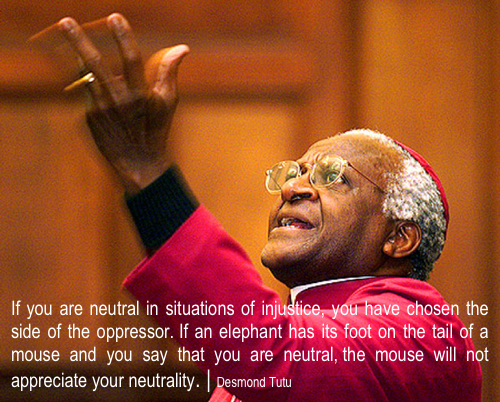 Click to enlarge, and read.

So why does Wikipedia make the choices that it does with regard to its Neutral Point of View Policy? What kinds of values are expressed by the Wikieditors who carry out and enforce that policy? Is the policy itself problematic? Is how it is carried out and enforced problematic? Where do the inconsistencies tend to crop up?