WikiInfoLit EOI Unit 3
Events of Instruction
1 - Gain Attention
Watch this video of Metaviews researcher, Sherida Ryan: Metaviews: Cognitive Authority.
- We are told to "Question authority!" Exactly what kinds of questions might you ask a supposed cognitive authority (expert) in order to judge whether he or she is really authoritative?
- If I were to tell you, "All cognitive authority is completely subjective and relative," would you agree or disagree? Why?
- Assume for a minute that all cognitive authority IS completely subjective and relative. What implications does that have for research?
2 - Describe Goal
In Unit 3, you will gain a more nuanced understanding of cognitive authority, including its problematic aspects, and of how it relates to research, critical thinking, and information literacy. You will explore how issues of cognitive authority are dealt with in Wikipedia and by Wikieditors.
3 - Stimulate Recall of Prior Knowledge
If you are a professor, a teacher, or a librarian, you are very used to being considered a cognitive authority for your students or patrons. But we're deluding ourselves if we think we can offer our students - and the readers of what we write - the answers, the right answers, all the answers. And we're deluding ourselves if we expect that from anyone else - even innovators, geniuses, and leaders in their fields. So it's our responsibility to pass on this balanced skepticism of cognitive authority onto our own students.
4 - Present the Material to be Learned
Many people, despite using Wikipedia frequently in their daily life, trust its information only in a very limited way. One of the biggest reasons for people's reservations about the trustworthiness of Wikipedia information is summed up as, "The information comes from anonymous people on the Internet." Watch this clip from a 2008 on the street survey by SurveyNation: Do You Trust the Information On Wikipedia?.
Far from accepting Wikipedia as authoritative and reliable, most of our students come to us with their skepticism already aroused by the conflicting messages presented by the media. But what our learners are lacking is the ability to articulate justifications for their skepticism, or to evaluate the authority and reliability of information sources for themselves. In other words, they know they should not trust anything completely, but they are at a loss how to tell exactly how trustworthy something is.
Read this excerpt from Ira Socol's "Irreconciliable Authority: Cognitive Authority, Technology, and the 21st Century Classroom", published by the Ira David School of the University of Michigan in 2007. As you read make note of each way that cognitive authority can be assessed:
-
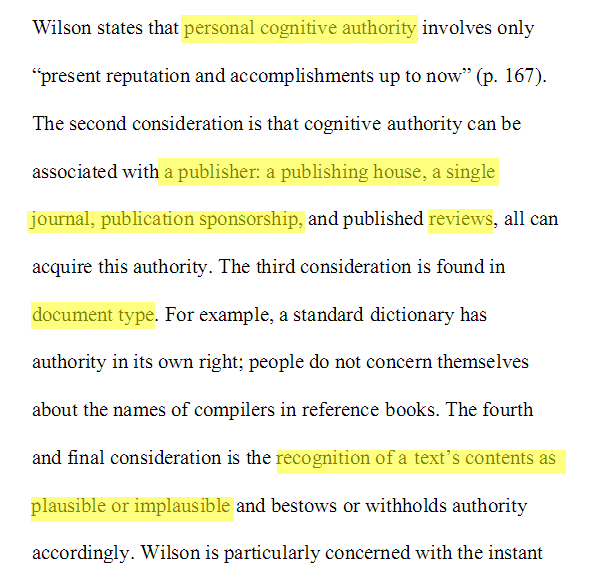 Click to enlarge, and read.

It is not necessary for every information source to look good by every one of those measures. Selecting resources that have adequate cognitive authority is more of a whole-picture thing.
Post your answers to the following question in the WikiInfoLit Google Group under Unit 3, Question 1.
- Imagine that your student, who is supposed to be writing a research paper on a science topic, is arguing that she should be able to use this web site as a source. Use two or more of the criteria mentioned in "Irreconciliable Authority" to explain point by point why that would not be a good idea.
Read these other two excerpts from "Irreconciliable Authority".
-
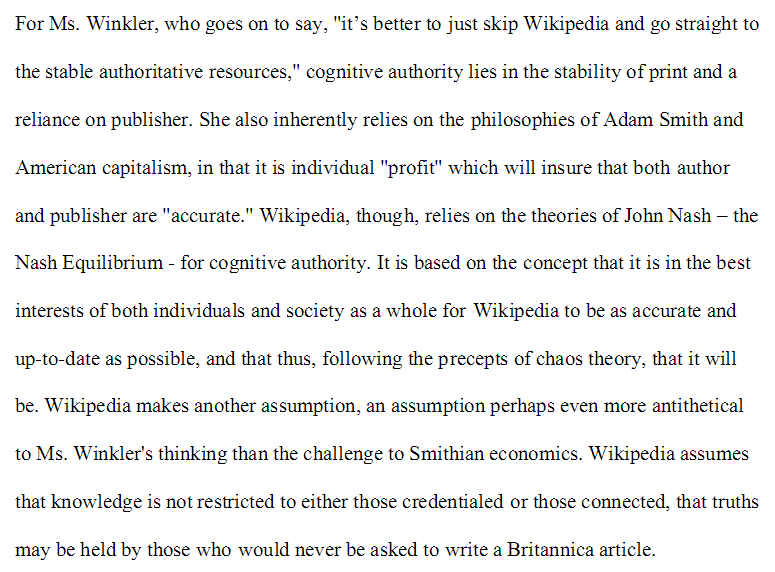 Click to enlarge, and read.
-
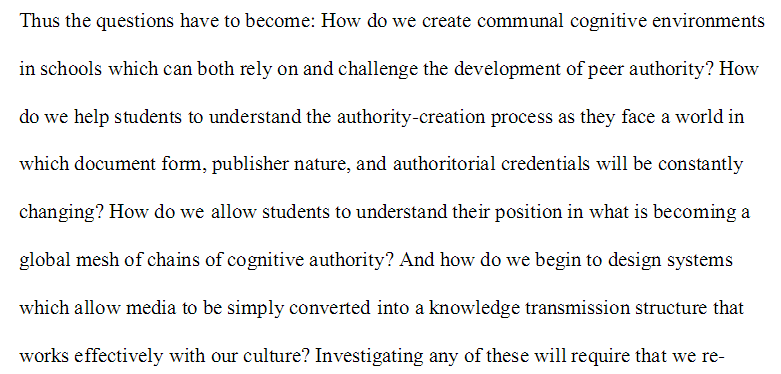 Click to enlarge, and read.


For a succinct summary of how cognitive authority can be taught to college underclassmen, read the following article. It provides a solid theoretical underpinning as well as practical ideas. Patrick Wilson's Bibliographic Instruction and Cognitive Authority, originally published in 1991 in Library Trends vol. 31 no. 3.
5 - Provide Guidance for Learning
Read these articles from "The Missing Manual" for Wikieditors:
- Wikipedia: Verifiability
- Wikipedia: Reliable Sources.
- Reliable Sources Noticeboard (you will sometimes have to click on the sub-sections to expand them.)
Answer these questions in the WikiInfoLit Google Group, posting under Unit 3 Question 2:
- In your own words (a paragraph or so) sum up Wikipedia's advice to its Wikieditors about what is the difference between a "reliable" and an "unreliable" source.
- As an academic, how do Wikipedia's ideas about "reliable" and "verifiable" sources stack up to your standards for and beliefs about cognitive authority? Are the sources "good enough"? Are the criteria for cognitive authority congruent with your own?
- Given what you have just learned, write a paragraph discussing how Wikipedia might figure in "[creating] communal environments and helping students understand "the authority creation process" "their position in what is becoming a global mesh of chains of cognitive authority."
6 - Elicit Performance Practice
Choose a Wikipedia page on a topic of interest. It should be a page with a lot of content and a strong Talk page. Using it as a centerpiece for your lesson, create an outline for a lesson plan for a specific target audience (age group/academic level!). It should revolve around three or four learning objectives having to do with cognitive authority and trusting the expertise and/or reliability of information sources. Your lesson plan should include a learning activity and an assessment based on the learning objectives.
Post your lesson plan to the WikiInfoLit Google Group under Unit 3, Question 3.
7 - Provide Informative Feedback
8 - Assess Performance; Test if Lesson Has Been Learned
9 - Enhance Retention and Transfer
Librarians often tell students to look for signs of cognitive authority, such as academic degrees and credentials, and publication by reputable publishers or journals in the field. We balance that by telling them to look to the content itself - its internal consistency and its consistency with what is reported in other sources or commonly known. A third check is its reception by the rest of the scholarly community. No one of these checks is infallible, and that is the hardest part to teach. Our students are time-pressed and anxious to "get it right". It is often necessary to reassure learners that it is more important that you can make a good argument for this source's authority, with evidence and clear reasoning, than it is to have a source whose authority only looks good on paper. Of course, looking good on paper is still important within academia. But whether in academia or outside of it, the ability to judge for oneself is crucial.