WikiInfoLit EOI Unit 4
Events of Instruction
1 - Gain Attention

Certain kinds of information sources, notably the news media and reference sources (like Wikipedia) are expected to be neutral. In fact, one of Wikipedia's most important policies is about the Neutral Point of View. Neutrality can be summed up as the motto of Fox News: "fair and balanced," which leads us to the inescapable fact that neutrality is often compromised, accidentally or for a persuasive or deceitful purpose.
Watch this clip from the Wikimedia Foundation, "Verifiability and the Neutral Point of View". Take some time to think about what advantages and disadvantages this policy might have in practice.
2 - Describe Goal
In this unit, you will come to understand the concept of neutrality, particularly as it pertains to Wikipedia's Neutral Point Of View (NPOV) policy. You will examine Wikipedia's successes and failures in maintaining a neutral point of view, and identify instances where particular Wikipedia pages have failed to present a neutral point of view about their topic.
3 - Stimulate Recall of Prior Knowledge
Please watch these animated characters discuss how neutrality can be sidestepped through the use of common conventions and devices. As the characters mention different ways to support one point of view while appearing to remain neutral, note them down. How To Produce Objective Journalism.
Neutrality became an important value for information sources after the World Wars, when people in western democracies had become sensitized to the power of propaganda. In a reaction against propaganda, the ideal became to present individuals with the information they would need to form their own opinions, without trying to influence what those opinions were. Again, to quote Fox News, "We report. You decide."
The neutral point of view is sometimes interpreted as presenting all sides with equal weight. Other times it's interpreted as presenting all sides that have a certain degree of plausibility, or a certain degree of popularity. As if that weren't problematic enough, you've already seen how neutrality can be an in-name-only kind of thing. And there is the argument that neutrality is not always an ethically sound position - see the image below.
-
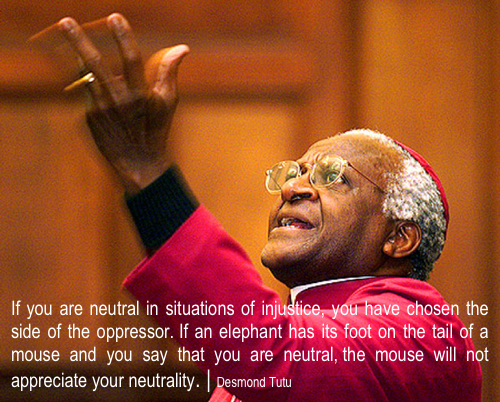 Click to enlarge, and read.

So why does Wikipedia make the choices that it does with regard to its Neutral Point of View Policy? What kinds of values are expressed by the Wikieditors who carry out and enforce that policy? Is the policy itself problematic? Is how it is carried out and enforced problematic? Where do the inconsistencies tend to crop up?
4 - Present the Material to be Learned
To see firsthand how contentious and problematic neutrality can be in Wikipedia, first watch An Enduring Wikipedia History: Upholding the Neutral on the Very Controversial Norman Finkelstein.
Then read Wikipedia's entry on Norman Finkelstein.
In the WikiInfoLit Google Group, under the post Unit 4, Question 1, answer these questions:
- The case of Norman Finkelstein's Wikipedia entry shows how difficult, complicated, and contentious achieving neutrality can be. What specific behaviors does Wikipedia require or encourage its Wikieditors to engage in in order to promote a Neutral Point of View?
- Some people passionately believe and can present evidence and logical arguments that Norman Finkelstein is antiSemitic. Others believe equally passionately, and can present evidence and logical arguments that he is not. Wikipedia's solution is to present both sides. Do you think they have presented each side with equal weight? Justify your answer with examples from the Wikipedia article.
- Do you think Wikipedia's Neutral Point of View is the best way to deal with controversial subjects? Why or why not? (Write a short paragraph justifying your opinion.)
5 - Provide Guidance for Learning
Your students may have passionate opinions regarding Wikipedia's neutrality on certain subjects. Even aggressively indifferent students tend to become engaged once they realize that they are not "sticking their necks out only to get them chopped." It's a great way to engage students in this crucial Information Literacy topic. But as educators learn from experience, passionate belief untempered by reason and civility do not make for the best learning experience - either for the individual or for the class as a whole.
This is an opportunity to draw up some ground rules for civil discussion. In the spirit of the topic, you can crowdsource the rules from your students. Here are some recommendations from EdChange.org
Help your students to mutually enforce your class's rules civil discussion. Equally important is your role in modeling and providing scaffolding for sound argumentation. ChangingMinds.org succinctly describes the Toulmin Model of argumentation (claims, grounds, and warrants), which you may wish to adopt.
6 - Elicit Performance Practice
In the WikiInfoLit Google Group, under the post Unit 4, Question 2, submit your response to this assignment:
Define your target audience and develop two to four learning objectives concerning Wikipedia's Neutral Point of View and what you have learned in this unit. Design a lesson plan based on those learning objectives, which should describe in detail a specific learning activity and assessment.
7 - Provide Informative Feedback
8 - Assess Performance; Test if Lesson Has Been Learned
9 - Enhance Retention and Transfer
Neutrality is anything but peaceful in Wikipedia. Arriving at a Neutral Point of View involves extensive debate behind the scenes, and sometimes even "edit wars." But the Neutral Point of View is so highly valued that it is one of the required criteria for an article to be judged a Good Article or a Featured Article. If you see either of these icons in the upper left corner of a Wikipedia article, you will know that the larger community of Wikieditors has judged them neutral.

