Lesson 1: Introduction to Culturally Responsive Teaching
Learning Objectives
The participant will be able to:
- Define culturally responsive teaching
- Discuss steps needed to understand and implement culturally responsive pedagogies
Introduction
Familiarity with culturally responsive teaching is an essential element of this course. This lesson provides an overview of the history and contemporary applications of what it means to practice culturally responsive pedagogies.
What is Culturally Responsive Teaching?
The term “Culturally Responsive Teaching” was first coined by Gloria Ladson-Billings in 1994 in her book The Dreamkeepers as an attempt to “challenge notions about the intersection of culture and teaching that rely solely on microanalytic or macroanalytic perspectives” (Ladson-Billings, 1995, p. 465). Ladson-Billings felt that amongst ongoing conversations in the education world surrounding improvements in education and teacher preparation, equity, and diversity, little was being done in terms of pedagogy, and pedagogy was often left out of these conversations.
Three Main Components of Culturally Responsive Teaching
Ladson-Billings proposed three main components of culturally responsive teaching:
- Focus on student learning and success: Supports students’ intellectual growth, moral development, and problem-solving abilities.
- Developing students’ cultural competence: Students develop skills that support their abilities to feel affirmed in their culture of origin and appreciate and have empathy for cultures.
- Supporting students’ critical consciousness: Refers to students’ abilities to identify and analyze real-world problems and recognize and critique societal inequities.
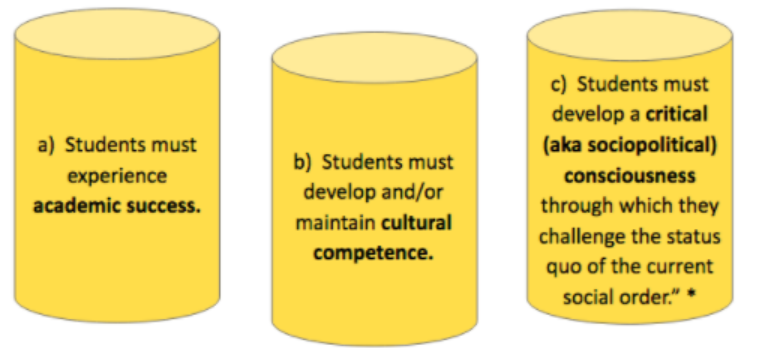
Screenshot from https://www.competencycollaborative.org/crse. CRSE Framework from the New York State Education Department in 2019, adopted by the New York City Department of Education.

Modern Perspectives on Culturally Responsive Teaching
Since Ladson-Billings' first work on culturally responsive teaching in 1994, there has been much research, conversations, and changes that have expanded on this original idea. There could be an entire mini-course on this, but for the purpose of this course we will look at and consider the concept of culturally responsive teaching with a 2024 lens.
- Paris in 2012 offered up the term “culturally sustaining pedagogy” “as an alternative that... embodies some of the best research and practice in the resource pedagogy tradition...” (Paris, 2012, p. 93). Paris chose to use sustaining instead of responsive or relevant because it demonstrates how this pedagogy seeks to “perpetuate and foster linguistic, literate, and cultural pluralism” in resistance to current school policies enforcing a monocultural society (Paris, 2012, p. 93).
- The New York State Education Department released their Culturally Responsive-Sustaining Education Framework in 2018. They define culturally responsive-sustaining education as being “grounded in a cultural view of learning and human development in which multiple expressions of diversity (e.g. race, social class, gender, language, sexual orientation, nationality, religion, ability) are recognized and regarded as assets for teaching and learning” (NYSED, 2018, p. 10).
Characteristics of Culturally Responsive Educators

This list is not meant to be exhaustive, but to give you an idea of some specific ways to practice culturally responsive-sustaining education in your own classroom and school community.
- Create a community of learners in which every student feels welcome and affirmed
- Maintain positive teacher-student relationships and teacher-parent relationships, giving parents and family members the opportunity to be involved in their student’s education
- Having high expectations for students and believing that all students are capable of academic success
- Maintain connections with the community and view teaching as a way of giving back to the community
- Being passionate about learning and knowledge, and incorporating multiple types of learning (i.e. social-emotional, collaborative) into instruction
- Identify inclusive curriculum by featuring resources that offer diverse perspectives and utilizing inclusive assessment strategies, such as providing scaffolds so that all students can demonstrate their learning
- Recognize that teaching is an ongoing process and seek professional learning opportunities to continually improve and expand their instructional abilities
Reflection: What other characteristics of culturally responsive educators can you think of? Add your response to the Padlet.
Activity
An important part of being culturally responsive is taking a look inward and examining our implicit biases. Harvard University's Project Implicit has an online test you can take to examine and reflect on your implicit bias.
After completing the quiz, take a few minutes to write a reflection on your experience. Some prompts:
- Were you surprised by any of the results?
- Which experiences in your life do you think have contributed to these biases?
- How can you make an effort going forward to address these biases?
Review
Lesson 1 Quiz: Use this link to access the review quiz for this lesson.
References
California Department of Education. (2024, April 11). Culturally relevant pedagogy. California Department of Education Educator Excellence. https://www.cde.ca.gov/pd/ee/culturalrelevantpedagogy.asp
Ladson-Billings, G. (1994). The dreamkeepers. Jossey-Bass Publishing Co.
Ladson-Billings, G. (1995). Toward a theory of culturally responsive pedagogy. American Educational Research Journal, 32(3), 465-491.
New York State Education Department. (2018). Culturally responsive-sustaining framework. https://www.nysed.gov/crs/framework
Next lesson: Lesson 2: Culturally Responsive Teaching & Music Education
Unit 1 Homepage: Unit 1: Culturally Responsive Teaching
Course Homepage: Supporting Cultural Responsiveness & Equity in the Music Classroom