Utilizing Processes to Solve Problems

Return to: Eric Fana's Profile Page
Return to: Engineering Design for All's Introductory Page
Return to: Module 1 - Defining Engineering Design Processes
Module 2 Overview
A design process is only as good as it user. Although EDPs are helpful tools for solving problems, they need to constantly be refined, adjusted, and practiced in order for problem solving to become efficient and effective. As you may have noticed in Module 1, EDPs, although structured, are rather open-ended when it comes to their first step {Defining the Problem}. Ideally, a design process can solve any and all problems that her user faces. Dangerously, users may rely too heavy on their EDP and loose their natural intuition and creative ability. Because of all this, during this module you will have ample time to dive deeper into the EDP process that you wish to implement in your classroom and support it using two important statements. By immersing yourself into your process you will be able to identify areas that may need a quick fix or affirm that your process works! Either way, we will look to broaden our understanding of engineering design through relate-able content, like the Scientific Method. Additionally, we will spend parts of this module addressing engineering designs role in the NexGen Science Standards. As you complete this module, it is my hope that you gain a better understanding of your process, thee processes, and it's relations to our professional standards.
Essential Questions:
- Why is defining a problem and design statement crucial to successful Engineering Design implementation?
- How does an Engineering Design Process compare to the Scientific Method?
- What do NYSED NextGen Science Standards state about Engineering Design?
Task Schedule
During this module, learners will...
- Instruction: Read, watch, and/or listen how the EDP compares to the Scientific Method (hereinafter SM). Discover how to write problem and design statements. See what NextGeneration Science Standards have to say about Engineering Design.
- Practice: Use their created design processes to solve an issue common in our daily lives.
- Test Your Knowledge: Decipher between problem and design statements. Reflect on the NextGeneration Science Standards.
Jargon Glossary
Taken from dictionary.com and/or wikipedia.org
- Design Brief: a documented plan or convention for the construction of a **design** - or object, system or measurable human interaction (*design is a very broad term used in an array of situations. For this mini-course, design will refer to (1) a process to solve problems, and (2) visual and physical traits used to describe an item.)
- Problem: any question or matter involving doubt, uncertainty, or difficulty.
- Solution: a means of solving a problem or dealing with a difficult situation.
- Needs: fundamental requirements that keep humans healthy and alive. (Ex. Basic Shelter)
- Wants: extra desires that can promote human happiness or other emotions. (Ex. 5-Story Mansion)
- Feasibility: the state or degree of being easily or conveniently done. (often done weighing positives against negatives)
Instruction
As discussed in Module 1, Engineering Design Processes are used to define and solve problems. Each of the processes we looked at had similar steps, often starting with a synonym for Step 1: "Define the Problem" and ending with a synonym for "Sharing the Solution". Being that EDPs are systematic, a strong foundation when solving almost any problem is highly desirable. To do so, engineers often make two statements; one to define the nature of the problem, the other to define what needs to be done to solve the problem. These statements not only provide justifiable reasons to pursue a solution, but also serve as reference reminder to come back to frequently as the problem is worked through. Together they form a design brief that can be shared with clients and peers.
- Step 1A: Problem Statement:


The first statement often comes easily as individuals or groups run into problems naturally throughout the course of the day. Problems range in severity and although many are easily solvable, some are much more complex. Enter Problem Statements. Problem statements allow use to put a title on what we are trying to solve. Importantly, problem statements merely identify the problem, define needs or wants, and may list constraints that may limit the solution. They rarely, if ever, include the solution. A good problem statement is precise and accurate (see right). After writing problem statements, professionals gain a better picture of what needs to be solved and can decide whether or not it is economically or feasibly worth solving.
Relating this concept to teaching: You grade a class quiz and determine that the class average is a 30%. Knowing that this is unacceptable, you write a quick note on your desk to address later. The note reads: "Most students in period four failed the kinematics quiz. They will have difficulty passing the state test later this year. Many will need this regents to graduate." This simple note serves as a problem statement.
- Step 1B: Design Statements:
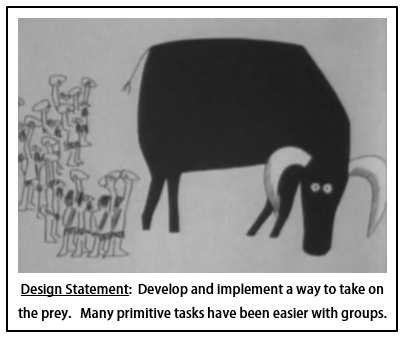

The second statement often comes much more difficult for some. Essentially, a design statement is a broad illustration of how the problem statement will be solved (see right). Broad, but precise, design statements may include criteria on how the solution will be judged by or other expectations that it should address. We are not looking for accuracy here. In other words, we are not looking for exact solutions to the problem, just enough to keep the ball rolling in future steps like "Generating Concepts". Getting too accurate can restrict the brainstorming power and creativity ability needed later. Unlike problem statements, design statements will not include the problem/issue.
Relating this concept to teaching...again: You grade a class quiz and determine that the class average is a 30%. Knowing that this is unacceptable, you write a second quick note on your desk to address later. The note reads: "Students in period four need additional time to learn Kinematics. The class average desired at the end of the unit is an 80%." This simple note serves as a design statement.
- Relating to the Scientific Method:


For those of you that teach science or simply remember participating in your grade school science fair, the EDP may remind you of another systematic process used to solve problems. Like engineering design, the scientific method is also used as a tool by engineers and scientists except this time to discover the wonders of the natural or artificial world. On many occasions engineering design actually includes the scientific method when existing knowledge or technology is not available. Both are heavily inquiry-based and have been around for ages. In recent years engineering design has taken a slight precedence as state and federal municipalities focus more on STEAM education.
Watch A Scientific Method Explaination for Kids (approx. 3 min) to help your understanding of this unique process. Play close attention to the procedural nature, the level of dedication, and the need for documentation - shared attributes of EDPs. Also play close attention to the step's terminology (hypothesis, conclusion, etc), the amount of observation, and use of variables - exclusive attributes of SMs.
Here are prime example of were each process could potentially be used to solve an unknown:
Scientific Method - used to determine how much the average toddler can lift.
Design Process - used to develop and create a new toddler toy that meets the new found weight limitation.
- A Glimpse of NextGen Science Standards:
The Next Generation Science Standards (NGSS) are K–12 science content standards to set the expectations for what students should know and be able to do. Since around the 1980s, science standards have seen litte change so NGSS has set the goal to improve science education for all students across the United States. Notably, NGSS defines Science and Engineering Practices as "what scientists do to investigate the natural world and what engineers do to design and build systems."
Mentioned earlier, this mini-course aims to help you as an educator introduce the EDP to your students as a means to address the release of NextGen Science Standards. Although we will not spend extensive time with these standards, I do want to convey them here to help us make a better connection between EDPs and education/curricula.

Key practices of engineering that NGSS framework identifies as essential for all students to learn are listed below. After a little rearranging, they very much resemble some of the EDPs we looked at in this mini-course. Bold terminology is designated exlusive to engineering design and not the scientific method.
- Defining and delimiting engineering problems
- Designing solutions to engineering problems
- Using mathematics and computational thinking
- Developing and using models
- Planning and carrying out investigation
- Analyzing and interpreting data
- Engaging in argument from evidence
- Optimizing the design solution.
- Obtaining, evaluating, and communicating information
- Final Thought: Albert Einstein (1879-1955), a world renowned German theoretical physicist, philosopher, inventor, and proclaimed genius once said, "If I had 60 minutes to solve a problem, I'd spend 55 minutes defining it, and 5 minutes solving it." As you continue to learn about the design processes and practice using the one you created, keep in mind that proper planning is the most important step of any process.
Practice
Instructions: It's finally time to break in the EDP you made last module. Again, these procedural tools for problem solving can vary in steps and complexity so testing them fully may take a considerable amount of time. It is recommended that you uses your EDP in a similar function that you would see your students using it in the classroom.
Document and follow the steps below to solve the problem:
- Re-write the problem statement (make it precise and accurate for you)
- Draft a design statement to solve the problem statement. (Remember, keep it broad and limit restrictive language)
- Follow the procedural steps to your EDP to solve the problem (alternatively, use a process that was discussed in module 1)
Cautious Note: Most EDPs are iterative, meaning that they repeat a series of steps over and over until a desired outcome is obtained. For this assignment, and to keep you sane, use the EDP no more than twice. We will accept as a cohort that the solutions presented are not perfect; this is often the case in life. Additionally, your model does not have to be functional; a 2D or 3D concept will work.
PROBLEM: Consumers continue to have a growing number of digital devices (phones, tablets, computers, televisions, etc) that require some level of electricity to either operate and/or require charging. Often, these devices are used in the same room and require power at the same time. Short cables and wires, overloaded outlets, and messy tangles are common problems that have infiltrated American homes across the country.
Submission: Once your finished: Upload and/or take a picture of your work and share it with the class. The Google Apps for Education Drive for this module has been shared. Access: DesignInAction.
Feedback: Feel free to explore your peers work and "comment" on at least one of the solutions uploaded. By doing so you will not only be helping each other but also exposing yourself to more content. Evaluation is an important step to learning, now is your chance to let it shine. Be positive and constructive, avoid negativity!
Going Further: Feeling ambitious? Get a group of friends together to re-tackle the design problem. Compare and contrast your individual effort to the group effort. Was one more successful than the other? Why might this be the case?
Test Your Knowledge
Task: Test Your Knowledge of Problem and Design Statements with a Quizlet Match - Problem OR Design Statement.
Quick Check: When you finish, share your thoughts about NGSS Standards, how they might effect your classroom, or what you found interesting about them. Alternatively, discuss how the scientific method is similar, differs, or could be paired with the design process. Post your reflection on TodaysMeet - NGSS-Implementation
Having trouble? Watch "TeachingChannel's NGSS:Science & Engineering Practices" (approx. 8 min)
Can You Answer?
- Why is defining a problem and design statement crucial to successful Engineering Design implementation?
- How does an Engineering Design Process compare to the Scientific Method?
- What do NYSED NextGen Science Standards state about Engineering Design?
If not, back track through the course, seek help from your peers or instructor, and/or pursue additional resources outside of this mini-course.
Ready to Move Forward?
Well done! You finished another module! One more to go!
During Module 3 we will look further into how Engineering Design Processes can be used in your classroom.
Visit Module 3: Implementing Engineering Design into STEAM Learning Environments
Module Specific References and Resources
"Getting to Know the Standards". Next Generation Science Standards; For States, By States: Retrieved October 2016, from http://www.nextgenscience.org/get-to-know
International Technology & Engineering Association (ITEEA),(2007). Standards for technological literacy: Content for the study of technology (3rd ed.). Reston, VA: International Technology Education Association.
PLTW (Project Lead the Way, Inc). (2016). Retrieve October 2016, from www.pltw.org
"Steps of the Scientific Method". Science Buddies. Retrieved November 2016, from http://www.sciencebuddies.org/
"Scientific Methods". StudyJams. Retrieved December 2016, from http://studyjams.scholastic.com/