Unit 3: Major difficulties in writing Chinese characters
After our lesson two, do you still think that Chinese characters are boring and meaningless to you as they used to be? Not really, right? Indeed now you are still at the elementary level of learning them, however, at least you have known the basic catalogues of different characters, how different types of them indicate different meanings. With those fundamental concepts, whenever you see a Chinese character, it is not meaningless to you any more, you will quickly search for your prior knowledge of what you already know and apply the result on the new character, the more you learn, the more you will know, and gradually, it will become a forward spiral.
In order for everyone learning writing Chinese characters more effectively and make less mistakes, let us see the major problems and difficulties learners usually confront, and by knowing these issues in advance, you will pay more attention in writing Chinese from the very beginning, therefore be able to develop a benign habit from the start. Let us begin now!
The Mastery of the Basic Strokes
This difficulty commonly exists in learners from western countries because their writing systems are phonography, which means the writing contains certain amount of alphabets thus people do not particularly need to learn how to write every word, however, in Chinese writing system, as we already known in the previous lessons that it is much more complicated since it contains different kinds of strokes, therefore without a solid foundation and proficient mastery of those basic strokes, one cannot complete writing the more and more difficult Chinese characters.So what are the basic strokes one must learn before writing good and pretty Chinese characters? In other words, what steps one needs to learn before he can run?
 A Simple Dot
 Horizontal Stroke, left to right
 Vertical Stroke, top to bottom
 Diagonal Stroke, falling from right to left
 Horizontal Stroke, falling from left to right
 Diagonal Stroke, rising from left to right
 Horizontal Stroke with a hook
 Vertical Stroke with a hook
 Slant Stroke with a hook
 Horizontal Stroke with a vertical turn
 Vertical Stroke with a horizontal turn to the right
In order to have a skillful mastery of these basic strokes, one must be practicing writing them often and repeatly, there is no short cut to the proficiency over night.
The Concept of Radical Structure
Now we have the character elements and components which are strokes, they play the role as what alphabets play in English words, and we made words by combing and constructing them together. However, at the same time, unlike English words which what we need to do is simply put different letters together, when it comes to Chinese characters, the construction also of great importance, which part need to write at which position makes significant difference.
Let us take two different simply characters as radicals first,
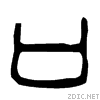

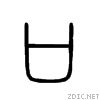
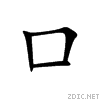 (Meaning "mouth")


Oracle Bone Script ——-------------—→ Seal Script ——-------------------—→Clerical Scrip
- Another radical is what we already learnt before 木(Meaning "wood")
And now let us put them together at different places to see how different the results can be:
 (Meaning "sleepy")
 (Meaning "dumb")
 (Meaning "apricot")
Aren't they give you a sensation as a transformer that with the same componential parts can come out with some totally different things? As for Chinese characters, they can be a total different new character with another meaning.
Therefore, what should we get from this section? From now on you should abandon the viewpoint that the concept of a complicated Chinese character is just simply put different components together. Different positions and different sizes are both important in deciding a new character and its meaning.
The Mastery of Strokes Order
Is that enough for writing good Chinese characters by knowing the basic strokes and how they need to be combined? I am afraid the answer is still not enough. Since most Chinese characters have many strokes, certain stroke orders were recommended to ensure the speed, accuracy and legibility in composition. There are generally nine guidelines in characters writing:
1. Write from top to bottom, and left to right
As a general rule, strokes are written from top to bottom and left to right
2. Write horizontal stroke before vertical stroke
When horizontal strokes and vertical strokes cross with each other, we usually write horizontal strokes before vertical strokes
3. Write character-spanning strokes last
If there are vertical strokes that pass through many other different strokes, those vertical strokes are written after the strokes through which they will pass
4. Write diagonals right-to-left stroke before diagonals left-to-right stroke
As a general rule, right-to-lefy diagonals are written before left-to-right diagonals
5. Write center before outside in vertically symmetrical characters
Usually in a vertically symmetrical characters, the components in the center position are written first, and then components on the left are written, and last write the components on the right side
6. Write enclosures before contents
The outside enclosing components are usually written before the inside components, and if there are bottom strokes in the enclosure, we write them at last
7. Write left vertical before enclosing
In a enclosure, the left vertical strokes are written first before the enclosing.
8. Write bottom enclosures last
Similar to rule number 6, the bottom enclosing strokes are usually written at last
9. Write dots and minor strokes last
Minor strokes such as dots are usually written last
Do It Yourself Time
Using the website Online English Chinese Dictionary and the Chinese characters you have already learnt and acquired so far, corresponding with each rule, and finding out the different strokes writing order in practice. The website will provide you with animation of strokes of order each character.
Distinguishing Characters with similar forms
Like any other languages, Chinese characters also have quite a few of them which have the very similar forms and usually difficult to distinguish and easy to get confused, especially for beginners. Except to collect and summarize them little by little, you can always use some skillful methods to tell them apart, and you can even create your own techniques to remember them.
- Relating to the Evolvement
Let us distinguish the following two characters:


 (Meaning "I or me")
Oracle Bone Script ——-------------—→ Seal Script ——-------------------—→Clerical Scrip

 (meaning "to look for")
Seal Script ——-------------------—→Clerical Scrip
If you have collected enough Chinese characters so far, it is not hard to get the meaning of the two radicals parts of 找, which the left radical "扌" means hand(s), and the right radical "戈" means dagger. In the ancient China, soldiers searcher for enemies using the weapon, and the meaning represents itself in the form of this character.
Therefore, relating its original meaning to the current form, the information you remember about this character becomes "a hand radical and a dagger radical. This is also another important reason that the basic characters are the most important ones that we need to sculpt into our mind.
- Creating a circumstance
What if it is not easy to get the meaning of a character's origin or there is no internet for you to look for the related information, well then you are always encourages to create your own ways of remembering and distinguish them. Let us take following characters as example:
 (Meaning "not yet")
 (Meaing "end", "at last")
How do we remember the difference between these two characters without knowing how they come into being? Imagine that you have a pencil at the beginning of the semester, and you draw a line of the same length as your pencil, at the end of the semester, becuase you are using your pensil every day, it becomes shorter, so you draw another shorter line below the first line, at the end you get two lines which the upper one is longer than the lower one, and that is how you create a circumstance to remember the meaning.
Do It Yourself Time
Use your brilliant head to come up with more and more good ideas about distinguish and remember different characters and share your thoughts with others in the DIY Time of Creating a Circumstance for Chinese Characters.
Go back to Mini Course main page