Unit 3: Establishing Options to Accomplish Their Educational and Career Goals
Mini Course Home: College and Career Planning in High School: A Mini Course Home
Portfolio: Matthew Sodano's Portfolio Page
Introduction
How to make a decision is always difficult for high school students. They can struggle making simple choices like what to have for breakfast let alone a major life choice! Student's understand the magnitude of choosing a path after high school which is why a lot of these students have so much anxiety about the future; feelings, emotions, and outside influences can some times get in the way of making a good choice. Jenna Manzo's KNILT page on goal setting and grit is a good resource for those who might want to explore the innerworkings of goal setting. That link can be found below:
For this course, we will use an abbreviated version by creating a weighted pros and cons list that will force students to think partially and help make an informed decision. Although emotion might not be ideally involved, it is understood that students are people, and that emotional attachments need to be thought about. The beauty of this is allowing students to make individual lists and allowing the weight of certain pros and cons to dictate an outcome rather than impulsivity.
It is important to note that the final scores are not the end all be all, instead, it is meant to separate options that might be far apart, or make a student think about some of their options differently.
Lesson
Read: The following article explains what a weighted pros and cons list is and the basis for how to make one.
Discuss: With a partner or group, discuss:
- Do you think emotion should be a part of decision making? Why or why not?
- What are some important items you believe all students should consider when making their list?
- How does adding a weight potentially change how people view a standard pros and cons list?
Do:
- For each of your 3-5 colleges, trade schools or job opportunities create a weighted pros and cons list with the following weights:
- +5 - must have
- +3 - would be nice to have
- +1 - would be an added perk
- -1 - not ideal, but you can live with it
- -3 - would not like
- -5 - hard no, cannot tolerate
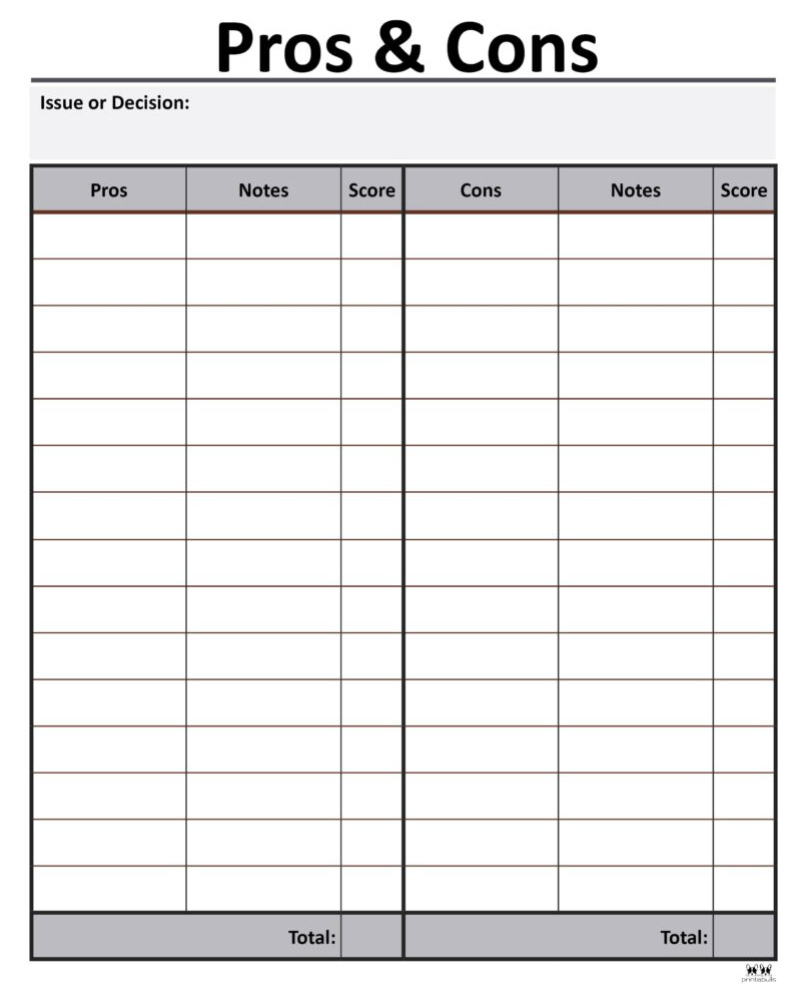
Figure 5: An example of a weighted pros and cons list template. Notes can be added for each pro or con and the score represents each weight. Feel free to make your own or use a technological resource to organize this information [2]
- In order of most preferable to least preferable, list your options in order of preference. Now students will have multiple options to get to their desired personal and professional career choice
- Research the criteria needed in order to apply to either the schools or jobs on your list. This might include the retrieval of transcripts, creation of resumes, obtaining recommendations, etc.

Point 1 is just and example of a list of weights. Feels free to change the numbers as you see fit based on your own class and students. Once the list is complete with the weights added, add up each option's total score. The highest score represents the option that is most favorable, and the lowest score represents the option that is least favorable.
However, it is important to know that the final score is only used to notice large differences between opportunities. Small variations in scores need to be more closely analyzed. Compare and contrast different lists that are close in score (anything less than a 3 point difference based on the example weights above). When the scores are close a student must look closely at what the pros and cons are and reflect on their own priorities. For example, a list that contains 5 cons that are all -1 compared to a list that has two -3's might need closer evaluation.
Reflect:
- Did anything surprise you about your total scores?
- Did your feelings change about a certain option after the list was made?
- Just because an option has a low score does that mean you should no longer consider it?
References
[1] Larson, M. B., & Lockee, B. B. (2020). Streamlined ID: A practical guide to instructional design. Routledge.
[2] Team, P. (2024, March 28). Pros & Cons list templates - 18 printables. https://www.printabulls.com/self-improvement-and-care/pros-and-cons-list-templates/
Previous: Unit 2: Finding Colleges, Universities or Careers that Match Personal and Professional Goals
Next: Unit 4: Create Useful Materials to Accomplish Future Goals
Mini Course Home: Mini Course Home Page Author Portfolio: Matthew Sodano's Portfolio Page