Unit 2: Understanding the key components of the science of reading.
From KNILT
Unit Overview
This section provides the learner with an inviting and engaging introduction to the topic of your mini-course, specifies the target learner, and gives an overview of how this course works. The importance of the topic may be demonstrated through problem scenarios, storytelling, case analysis, statistics, etc.
Feel free to name and organize this section (and other sections) in a way that is most effective for your mini-course. For example, designers from the past sometimes set this section into two parts: Introduction, Course Overview (How This Course Works).
Unit Learning Objectives
After completing this unit, participants will:
Understand what "breaking the code" means.
Identify the key components (breaking the code) of the science of reading. Describe the key components of the science of reading.
Explore the interactive programs that could be used daily to support students learn reading and spelling.
Participate in activities by answering questions.
Unit Lessons
This unit includes the following lessons. Click the lesson title to complete the task (lesson) page.
Unit 2 - Lesson 1: Breaking the code!
Unit 2 - Lesson 2: Interactive Programs
Unit 2 - Lesson 1: Breaking the code!
Learning Objectives:
After completing this unit, participants will:
Understand what "breaking the code" means.
Identify the key components (breaking the code) of the science of reading. Describe the key components of the science of reading..
Participate in activities by answering questions.
Mini- Lecture- Lesson 1
What are the 5 components (Key concepts) of the science of reading?
The Five Concepts of Reading are:
Phonemic Awareness
Phonics
Fluency
Vocabulary
Reading Comprehension
Phonemic Awareness is the ability to hear, identify, and manipulate the individual sounds in spoken words. They are able to understand that spoken words are made up of one or more sounds. Students can develop phonemic awareness ability by participating in different activities such as blending sounds, rhyming, segmenting words, identify first, middle, and last sound in words, blending syllables, etc. Phonemic Awareness help students break down unfamiliar words to read them.
Phonics is a method of teaching students reading spelling by focusing on the relationship between letters and the sounds. It emphasizes in teaching students phonemes and graphemes. Phonemes are the individual sounds and graphemes are the written symbols that represent phonemes (letters). In the science of reading, phonics plays an essential role as it support students to "break the code" of how to read. Students will learn the different spelling and sounds rules instead memorizing words.
Fluency is the ability to read sentences with accuracy, expression, and speed. Developing reading fluency is essential to enhancing comprehension, as it allows students to focus on context and understand the meaning of the words quickly. Fluency requires students to have automaticity in decoding words so that reading becomes fluent.
Vocabulary in the science of reading is crucial to supporting students in developing reading comprehension. If students have advanced vocabulary, they will have a deeper understanding when reading and listening. They will also be able to better express their ideas during discussions and in written form.
Reading comprehension is the ability to understand, interpret, and infer what has been read. Reading comprehension is an essential part of reading science, as it is the ultimate goal of reading instruction.
Video:
In these two videos, you will continue to learn about the five components of the science of reading. It is also important to understand that explicit and systematic instruction needs to happen in order for students to develop these skills (phonemic awareness, phonics, fluency, vocabulary, and reading comprehension).
For this lesson, you will read the following articles to develop a deeper understanding about some of the key components of the science of reading.
Articles:
The Science of Reading Explained: Fluency (https://www.edmentum.com/articles/the-science-of-reading-explained-fluenc y/)
Phonological awareness and phonemic awareness: what’s the difference? (https://www.readingrockets.org/reading-101/rea ding-101-learning-modules/course-modules/phonological-and-phonemic-awareness)
Activity:
For this activity, you will use the Padlet platform to write down your answer to complete the task.
Click on the link (https://padlet.com/mnunezalmonte03/five-components-of-the-science-of-reading-t16jm7gpt9di2h4w)
Task: Describe at least 3 of the key components of the science of reading. Use the link to open.
Unit 2 - Lesson 2: Interactive Programs
Learning Objectives:
After completing this unit, participants will:
Explore the interactive programs that could be used daily to support students learn reading and spelling.
Understand how interactive programs support students learning how to read.
Participate in activities by exploring different online programs, reading, and note-taking.
Mini- Lecture: Lesson 2
As an educator, it is essential to know the different resources you can use to support students when they are learning how to read.
For this lesson, you will have the opportunity to explore different interactive programs online. The University of Florida Literacy Institute provides these online programs for teachers in all grades. They can be used by teachers, reading interventionists, speech therapists, coaches, etc. These programs are an excellent resource for educators and students. All these interactive programs are free and can also be used at home. It allows students to build, blend, and segment words.
Interactive Programs:
To explore the different interactive programs, you can read each description and click the link.
UFLI Virtual Blending Board: The Virtual Blending Board should be used in most lessons during in grades K to 2nd. The Virtual Blending Board is designed for the teacher to project and manipulate, while students build their decoding automaticity by reading the words the teacher forms while students can use the online version on their devices.
Click Link to Blending Board (https://research.dwi.ufl.edu/op.n/file/bca9ju45kvvrvoan/?embed)
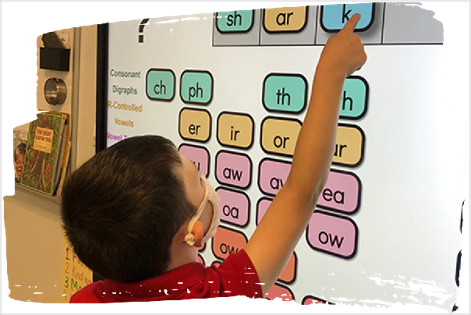
Virtual Word Work Mat: The Virtual Word Work Mat can be used in most lessons during word work or any time students need to use manipulative letters for encoding and decoding practice. The Word Work Mat can be used by the teacher, the students, or both, to practice reading and spelling words. The Word Work Mats can be projected or used on individual devices by students.
Click the Link to Access the Word Work Mat (https://research.dwi.ufl.edu/op.n/file/cbhd8xmn9i4ctf7i/?embed)
Intermediate Word Work Mat for upper grades. Once you reach the Digraphs Unit you should begin using the Intermediate Word Work Mat. Use the word chain provided in each lesson plan to provide words for your students to encode and decode. Students can use the mat on their devices or printable while using a sheet protector and dry marker.
Click on the Link to Access the Intermediate Word Work (https://research.dwi.ufl.edu/op.n/file/gc8nkxns914enc7 d/?embed&fbclid=IwAR1OiYiB6fERCg-3wSWOPc0QZh4cmzyZ7wdO7f fU2c4trzyanvj1xebko)
Activity:
Think about all the interactive programs you just learned about. Answer the following questions to reflect. You can answer the questions on the Google document or any other choice.
1. Which one was your favorite interactive program?
2. How will you start using them during instruction time?
3. Do you think these interactive programs can be beneficial for your students? Explain
Click on the Link to Access Document (https://doc s.google.com/document/d/1B7U14in20SlA-MctLS pSNf-FrfRuf0W7jlCTKmbxm6A/edit?usp=sharing)