Unit 1: Sort Your Sources


Sources on the World Wide Web
The internet is a vast sea of knowledge, but not everything you read online is true, in order to face this reality head-on, readers have to utilize critical thinking skills to reflect on the validity of the source found. Researchers agree with the progression of reading online on a daily basis, well-developed literacy skills are necessary to divide what is factually correct and what is not. So in order to prepare students for life in the 21st century, teachers must educate this new generation on how to effectively navigate the internet. Currently, students struggle to evaluate the sources in front of them due to a lack of skills or effort to authenticate the information. (Kiili, et al. 2008). The goal for this unit is to understand what sources on the internet are reliable and unreliable as the next unit will be teaching the same evaluation techniques in appropriate bite-sized chunks for adolescent use.
What is a Source?
Let’s get down to the source, by defining what a source is. A source is an outlet of information that can be in the form of a text (article or webpage) or person (author responsible for creating the document). In the field of history, when a source like an artifact is found that was created long ago, an in-depth cross-checking process takes place by historians as aspects such as the artifact’s author, time of origin, and intended purpose play a role in determining whether the source is valid in the light of what is known (Goldman & Scardamalia, 2013). A similar process should be made today in digital texts as websites found on the internet can make any source seem like real news. It is important to remember that the purpose of journalism is to provide the reader with reputable information so he/she can make informed decisions, so if a source is not providing you that opportunity, chances are you cannot trust it.
Reliable sources are well-constructed arguments backed up by valid pieces of evidence. Sources that you can rely on often have links to corroborating findings, maintain an unbiased stance, and peer-reviewed before publication. Unreliable sources are the opposite, these sources are not accurate nor professional as they attempt to sway you away from the truth by promoting an alternative agenda. One would think credible sources would be easy to spot, but unreliable sources try to disguise themselves as the real deal to persuade the unlucky reader to believe what is on the page is true (Lee, 2020). You may have some ideas on what you look for when evaluating a source, below is a great video that highlights what to spot for:

Reliable and Unreliable Indicators
What to look for in a source? Say you just got done watching Pixar’s Finding Dory and was fascinated by Hank the octopus and want to look into more octopi in the Pacific Ocean, how would you know what you are looking at is real? Looking at Author, Date of Publication and Motivation are key aspects into determining how credible a source is. Reliable and not reliable examples will be provided that highlight what to look out for, in this case, when “octopus on the pacific coast” is searched on Google.
Author

It could be a book, a website, or a scholarly journal, the person who wrote it has a great deal with the fidelity of the source. It may be useful to look into some details about the author.
- Name: Be sure there is an actual author to back up the source, if the individual is willing to put their contact information it usually means they will discuss their ideas further proving them to be creditable. Be wary of trusting a source without an author, unless it is from a trusted source.
- Expertise: Look into the qualifications of the author, what makes this person qualified to speak on the subject? If you are reading an article on an upcoming election, it makes more sense to trust the professor of political science rather than an opinion from a concerned citizen.
- Domain: Where this is being posted matters, a website that ends with .edu or .gov has the credibility of a university or government agency respectively, while a .com could have been created just to sell me something. Be careful of blogs or wikis in the URL, they may have the right information, there may be credible authors critiquing the page, but if anyone can post on the page, then you could be looking at information that was manipulated by a non-expert and/or is strongly opinionated.(Identify bias, 2021)


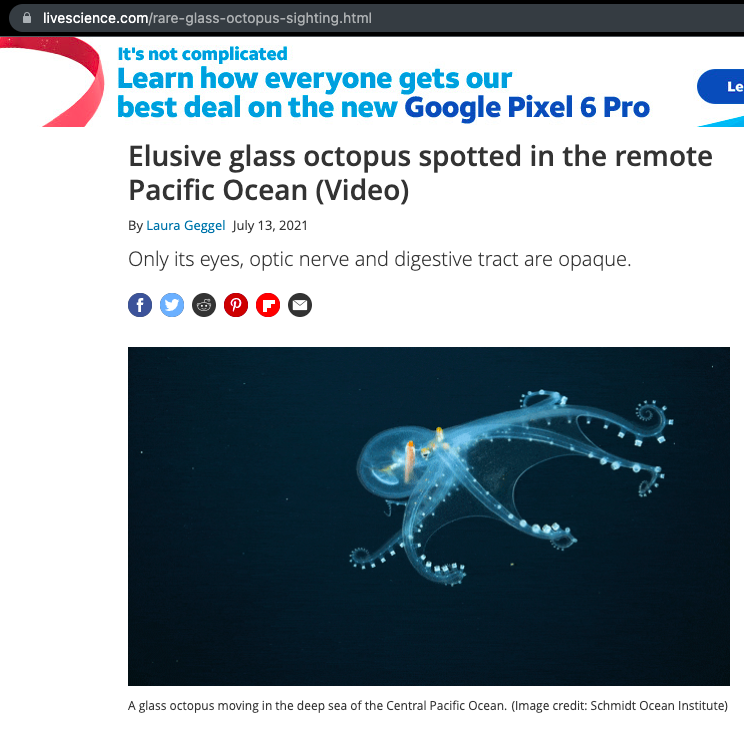
Reliable Example: This source from Live Science may seem fabricated at first glance, but by looking at the author we can get some more insight. If the user clicks on the author, it takes you to Laura’s page that explains that she is an editor for Live Science and has quite the repertoire in the fields she covers, where her work has been published and the awards she has won.
Unreliable Example: This source is on the first page of results and has lured people to believe that there is a species of octopi that live among the trees. One of the giveaways that this is a poor source is that it says it is a blog in the top left corner which means none of the information is peer-reviewed and parts could be created by anyone. At the bottom of the about page, it gives credit to Lyle Zapato which is hyperlinked to his page that promotes conspiracies.

Date of publication

Any resource you see will reflect the society and time in which it was made. If any of these details make you second guess the accuracy, you may want a more current source.
- Time: How much time has passed from when it was created to now? It is possible that details such as names, locations, and predictions may be inaccurate.
- Freeze Frame: Older documents show us what life was like at a certain point in time, but that does not mean the same ideas and attitudes are true today.
- Everchanging: Even if the source is only a few years old, it may not be the most recent data out there, especially if it is part of an ongoing story or developing theory. (Identify bias, 2021)

Reliable Example: The 9 Amazing Octopus Species article was posted on January 24, 2021, which suggests it has the most up-to-date information on the Octopoda. The website Treehugger covers everything sustainability from gardens to beauty products so it makes sense that they would do an exposé on an invertebrate that is greatly impacted by humans.
Unreliable Example: Under the Sightings tab for The Pacific Northwest Tree Octopus, are user-generated posts that claim to see the tree octopus species. Out of the 19 sightings reported, only 3 are within a decade of November 2021. If this website was established in 1998 and only has a handful of sightings, most of which are outdated, it is safe to say you should not use this source.
Motivation
By investigating why this source was published may lead to how truthful it is. Make the judgment whether the text is trying to educate or persuade the reader, as using emotions and false information can be very convincing.
- Evidence: The facts that are included are substantial to the validity of the source. The more references that are embedded, the more reliable the source is as their narrative is being backed up by multiple alibies. However, double-check those references to make sure they are real sources from credible platforms and not cherry-picked to support one side of a debate.
- Bias: This is when there is prejudice for or against a thing, person, or people, usually in a method that is unfair. Bias can be present anywhere, so it is important to point out factors that make the source have a narrow viewpoint such as:

- Heavily opinionated/one-sided
- Relies on unsupported claims
- Presents opinions in the form of facts
- Language is inappropriate or influenced by emotions
- Trying to sell you an idea or a product
(Identify bias, 2021)
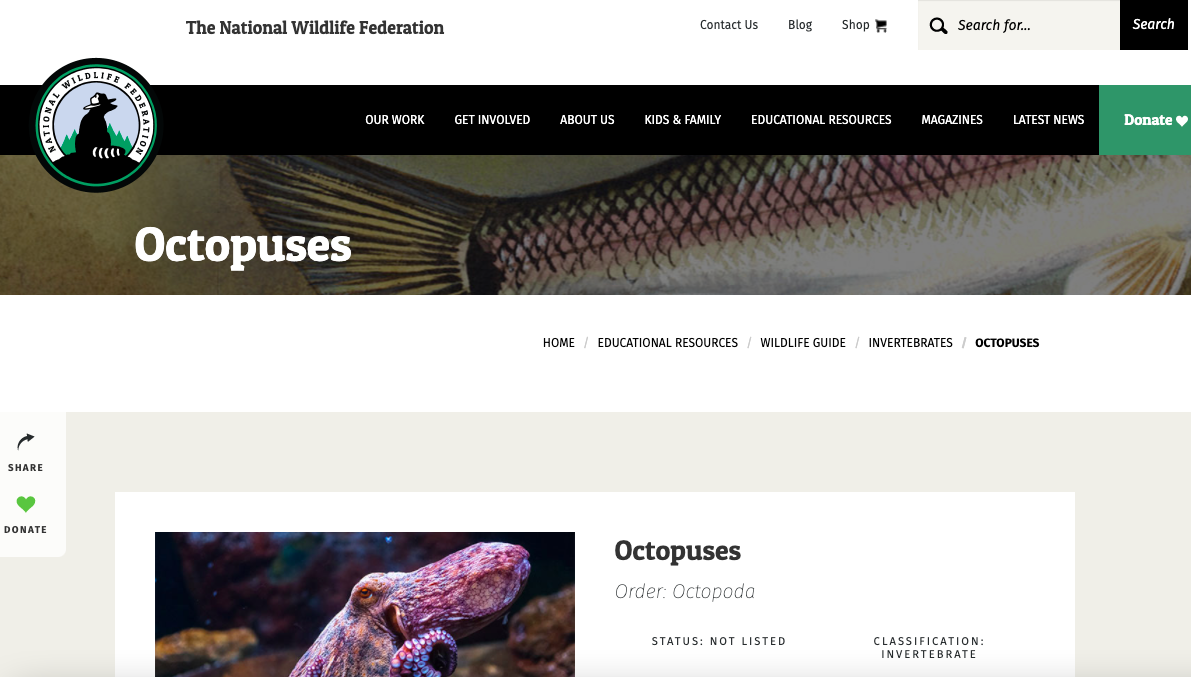
Reliable Example: This article on Octopuses seems like a good source from the National Wildlife Federation, but some further investigation should be made in order to confirm this theory. This source is categorized under educational services which means its purpose was designed to teach others, the evidence they bring up is cited at the end to back up their findings. One can notice they donate buttons attached to the article, by clicking on the Our Work tab, it describes the mission statement to protect wildlife at all costs. The NWF describes that they are largely supported by conservation supporters which put the funds towards the animals first and the workers second.

Unreliable Example: In the HELP! Tab for The Pacific Northwest Tree Octopus, the page suggests using activism and buying the website’s products to promote awareness. If you go to the gift shoppe, the image of the tree octopus is used on objects from mugs to shirts. Nowhere in the shoppe does it say that any profit will be donated to this “endangered” species, so one can assume that the author is promoting this animal to trick people into buying his products.
Below is a helpful video that may help you (and your students in the next unit) determine the reliability of a source:
Unit 1 Activity
After learning about sources on the internet, you will find examples of reliable and unreliable sources due to it’s author, date of publication or motivation on Google.
You will fill out a chart with the following: 1. Include the URL (copy and paste the website) of the source. 2. Provide an explanation of why the author, date of publication or motivation makes it a reliable or unreliable source.
You do NOT need to find one source for reliable and one source for unreliable to fit all of your needs, each example can be from a different source and do not even need to be related to one another, I just want you to find examples that you can distinguish are credible or not.
Click the link below (you will need a google account to access it), find a blank page, write your name and begin!
https://docs.google.com/document/d/1uCgfCQXYiDFR72qkwOObFR_F_t1IJx5UJeo2Yookxk4/edit?usp=sharing
References
Goldman, Susan & Scardamalia, Marlene. (2013). Managing, Understanding, Applying, and Creating Knowledge in the Information Age: Next-Generation Challenges and Opportunities. Cognition and Instruction. 31. 10.1080/10824669.2013.773217.
Kiili, C., Laurinen, L., & Marttunen, M. (2008). Students evaluating internet sources: From versatile evaluators to uncritical readers. Journal of Educational Computing Research, 39(1), 75–95. https://doi.org/10.2190/ec.39.1.e
Lee, H. J. (2021, February 8). How to distinguish between reliable and unreliable sources online. INKspire. Retrieved November 11, 2021, from https://inkspire.org/post/how-to-distinguish-between-reliable-and-unreliable-sources-online/-MKNvPDSaxfUKjIneDIr.
State Library of Victoria. (2021). Identify bias. Ergo. Retrieved November 4, 2021, from http://ergo.slv.vic.gov.au/learn-skills/research-skills/select-resources/identify-bias.
On to Unit 2?
Click here: Unit 2: Students and Sources