Level 3: Implementing Game-Based Learning in the Classroom
Navigation Links:
- ETAP 623 Spring 2023 (Zhang)
- Alicia Esposito's Portfolio Page
- Game-Based Learning in the Music Classroom

Level Objectives
During this unit learners will:
- Analyze their general music curriculum and its alignment with current educational standards
- Select lesson materials that support student learning goals
- Design a lesson that includes:
- learning objectives that align with the appropriate educational standards
- a game-based element that supports the chosen student learning goals
- assessment of student learning and effectiveness of the applied game-based approach
Curriculum Analysis
Before we can implement GBL into your lessons, you must first take a look at your current curriculum and identify its alignment with the learning standards. Below are the learning standards for elementary general music classes at both the national and state levels (I teach in New York so these are the NYS standards. If you teach in a different state, you will need to look at the standards for your state).
NafME General Music Standards (PK-8th Grade)
NYS Music Learning Standards (All Levels)
Be sure to keep up-to-date with the national and state music learning standards as they can update and change over time! This is especially important if you work in a district that leaves the design and structure of your curriculum to your discretion.
If you need help constructing your curriculum, check out this Curriculum Framework Guide for general music.
Selecting Games

Using the resources provided in Level 2, select a handful of games that could be used in your classroom and identify which learning goals would be supported by each game.
Make a copy of this chart and compile some games for later reference. This is a great way to practice using a variety of resources!
I filled in one row for you as an example. The game I chose is called Al Citron, a Mexican stone passing game. The lyrics are a mix of Spanish words and nonsense words, provided on the Mama Lisa's World website. The site also explains how to play the game, gives some background/cultural context, and some audio and video samples so you can hear the song and watch the game being played. This circle game fits perfectly in my Music Around the World unit and satisfies both the Performing and Creating national general music standards. Give it a try!
Final Boss Battle
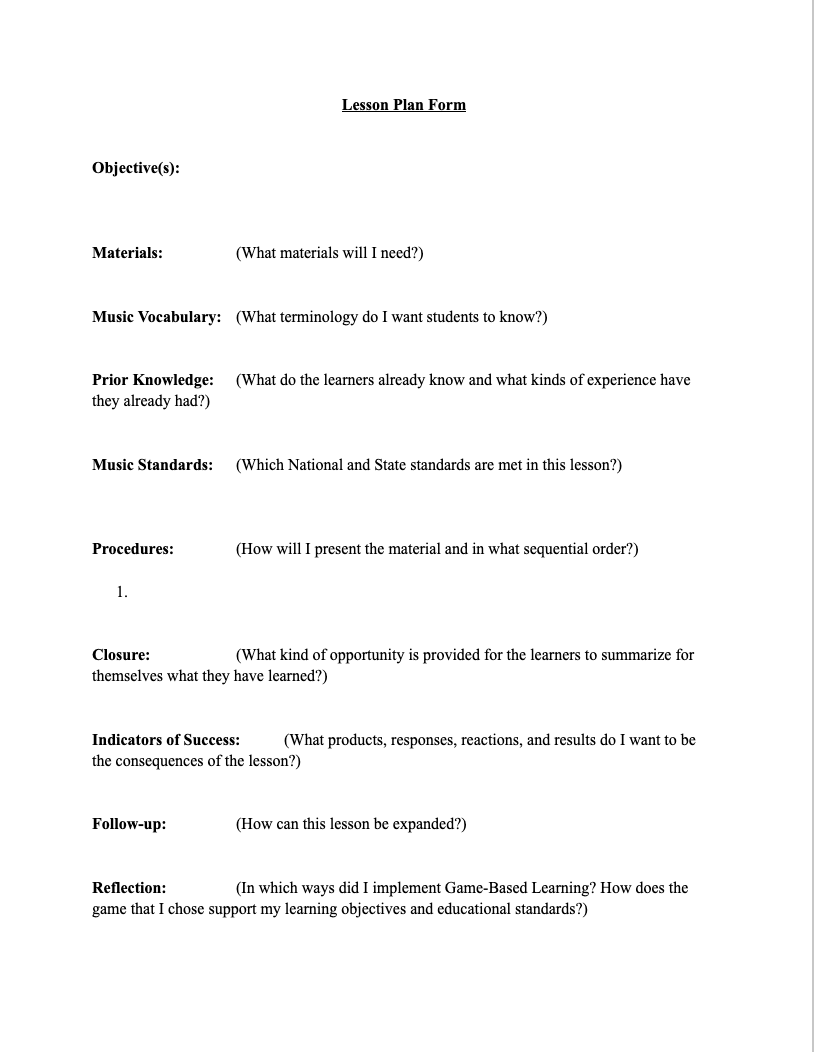
The time has come to put all of your new skills to the test! In the final portion of this mini-course, you will design a short lesson that appropriately implements game-based learning while aligning with your lesson's learning goals and educational standards.
In your lesson be sure to include:
- Learning Objectives
- What do you want your students to learn from this? Use Bloom's Taxonomy for each objective.
- Prior Knowledge
- What should your students already know prior to this lesson? How does this fit into your curriculum?
- What should your students already know prior to this lesson? How does this fit into your curriculum?
- National/State Standards
- Which National and State educational standards are supported by your lesson?
- Game and lesson procedures
- How will you present the information and in what order? How long will each step take?
- Student Assessment
- How will you know whether or not your students are successful? Which type of assessment will you be using?
- Lesson Reflection
- Why will your implementation of game-based learning be successful? What about the game you chose makes it an effective tool for this specific lesson?

Make a copy of this lesson template to help you plan your implementation of GBL.

End Credits
Congratulations, you are now a master of game-based learning! With your new tools and knowledge, you are ready to wield GBL as your educational sword in the everyday battle of elementary general music. Whether you use circle games, educational video games, or something else entirely, you are doing your students a great service by familiarizing yourself with the benefits of GBL. I guarantee you will see a difference in your students' engagement, problem-solving skills, and much more!
You can use these links to return to the Course Homepage, my Portfolio Page, or the ETAP 623 Spring 2023 class page.
Happy gaming!
References and Resources
2014 music standards. NAfME. (2021, April 1). Retrieved May 7, 2023, from https://nafme.org/my-classroom/standards/core-music-standards/
Hedden, D. (2000). General Music Curriculum Framework Document. NAfME. Retrieved May 7, 2023, from https://nafme.org/my-classroom/journals-magazines/nafme-online-publications/general-music-curriculum-framework-document/
Formative and summative assessment: Center for innovative teaching and learning. Northern Illinois University. (n.d.). Retrieved May 7, 2023, from https://www.niu.edu/citl/resources/guides/instructional-guide/formative-and-summative-assessment.shtml#:~:text=There%20are%20three%20types%20of,diagnostic%2C%20formative%2C%20and%20summative.
Mcdaniel, R. (1970, June 10). Bloom's taxonomy. Vanderbilt University. Retrieved May 7, 2023, from https://cft.vanderbilt.edu/guides-sub-pages/blooms-taxonomy/#:~:text=Familiarly%20known%20as%20Bloom's%20Taxonomy,Analysis%2C%20Synthesis%2C%20and%20Evaluation.
NYS Music At-A-Glance Standards. NYSED.gov. (n.d.). Retrieved from https://www.nysed.gov/sites/default/files/programs/curriculum-instruction/nys-music-at-a-glance-final-8.2.2017-high-res-v2.pdf