Kate Rosen's ID portfolio
This is a template for the ID portfolio page, where you will document your instructional design work in progress during this semester. This template is used to organize your own portfolio page. DO NOT EDIT the template page itself. See the video guide on how this project works and how to set up your ID portfolio page: Zoom Video If you need to see examples, see Gërt Arnold Portfolio Page; Sarah Stolberg's Portfolio Page.
Navigation links: ETAP 623 Fall 2026 | Link to my mini-course front page
About Me

My name is Kate Rosen, and I graduated from SUNY Cortland with my degree in early childhood and childhood education. I currently teach third grade and am getting my master's in curriculum and instructional technology. My experience working with children started at 13 years old. I have been a teaching assistant, camp counselor and supervisor, and a tumbling and dance coach. Being a teacher was always my dream growing up, and I am excited to be able to share something I am passionate about with other teachers and individuals in the education field.
My Topic and Purpose
In this course we will dive into project-based learning for elementary-age students. With an elementary-centered background, I have found many benefits to project-based learning and inquiry. I think it's critical for students to understand how their education relates to the real world. As a student, I did not learn best through the typical methods of textbooks and reading, even if they can be helpful. I discovered that applying what I was learning through practical situations improved my comprehension and memory of the material. Elementary students can actively interact with the material, solve issues, work with others, and draw significant connections between what they learn in the classroom and the real world through project-based learning. Although this course is catered to early-level education, project-based learning can be applied in all education for all ages.
Scope of Learning Outcomes and Content
This course is designed to provide teachers a project-based learning (PBL) simulation that can guide future planning for a project-based learning approach. After this, teachers should feel knowledgeable about what PBL is and what it isn't, how to actively design and assess, and tips for facilitating.
In this course, users will address these questions:
- What is project-based learning, and what isn't project-based learning?
- How do I effectively design a project-based learning experience?
- How would I facilitate students working to get the most out of the experience?
- How would I assess and reflect for future planning as a project-based, learning-centered classroom?
Needs Assessment
The Educational Problem
Project-based learning (PBL) allows elementary teachers to increase student engagement and provide opportunities for students to access real-life applications to problems. PBL increases collaboration and inquiry-based learning. Research is not ultimately conclusive that PBL is the end-all, be-all curriculum. The instructional problem lies more in the fact that elementary teachers are not educated on PBL. Teachers may understand that PBL involves student-centered learning, authentic problems, collaboration, and a final product but may need more training on how to effectively plan and carry out a PBL experience. We need to close the gap where teachers understand what PBL is but lack the knowledge on how to implement it correctly.
The Learners
The primary audience for this course are elementary classroom teachers who are eager to incorporate project-based learning into their instruction. Learners may have varying levels of prior experience with PBL. This course is intended for practicing teachers who have existing curricula.
Analysis of Gaps
| What Teachers May Know/Do | What Teachers Need to Know/Do |
|---|---|
| Teachers may know that PBL involves students working on projects. | Teachers can explain the essential characteristics of PBL and distinguish from just assigning a classroom project. |
| Teachers may understand that PBL can increase class engagement and provide real life learning experiences. | Teachers can identify when PBL is an appropriate instructional tool and connect the project to specific standards and curriculum. |
| Teachers may have limited experience in designing a project from start to finish. | Teachers can develop a basic PBL plan that includes a driving question or problem, learning goals, inquiry based learning, and student work. |
| Teachers may anticipate difficulties with group work and classroom management. | Teachers can establish clear expectations and classroom "norms" that support productive group learning. |
| Teachers may rely heavily on traditional summative assessments, quizzes, worksheets, etc. | Teachers can use formative and summative assessment strategies with PBL. Teachers could implement rubrics & make observations. |
The most important gap is more of a knowledge and skill gap rather than an awareness gap. Teachers need more experience in implementing PBL, not necessarily on the core components of PBL itself.
Existing Efforts
Professional development, PBL-focused curriculum, online resources, and school-based initiatives are some of the ways to address the gap. This mini-course is developed to be a point of information and narrows the focus on how to implement PBL.
Intent Statement
The goal of this mini-course is to assist elementary educators in gaining the essential knowledge, hands-on skills, and confidence required to comprehend the advantages of project-based learning and to start integrating age-appropriate PBL activities in their classrooms. This course will give an example of a PBL unit study in order to guide educators in creating their own.
Analysis of the Learner and Context
Learner:
The primary audience for this mini course are practicing teachers of all subjects. PBL can be incorporated into all major content areas: math, English language arts, science, and social studies. PBL can be used in all of these content areas or primarily focused on one area. Participants in this course may also include curriculum writers and professional development coordinators. PBL can be used in most elementary grade levels but works the best for upper elementary (3-5). Participants will bring their own experiences, classroom schedules, resources, and different needs. These experiences will contribute to the planning and execution of the PBL.
Instructional Context:
Participants will complete the mini-course independently through KNILT and will be able to work through at their own pace. The course will include visuals, examples of PBL, and a space to reflect and get started with their own planning. Learners will use their own experience and knowledge of curriculum to guide instruction.
Time & Resources:
This mini-course is self-paced. Participants can complete it on their own schedules. Learners will need a device that has access to the KNILT platform and course. It would be helpful for participants to have an existing curriculum to reference while completing the course.
Performance-Based Objectives
After completing this mini-course, learners will be able to:
Plan:
Learners will be able to design a standards-aligned PBL experience with a driving question, measurable learning goals, learning activities, and a final product.
Implement:
Learners will be able to develop an implementation plan that sequences project activities, promotes student collaboration and inquiry, and includes the necessary scaffolds for elementary students.
Assess:
Learners will be able to create a rubric and assessment plan to measure student learning, then provide feedback.
Task and Content Analysis
Before taking this course, the learner:
- should have knowledge of an elementary classroom learning environment
- should have a basic understanding of how to plan for elementary-level instruction
- should have an educational background
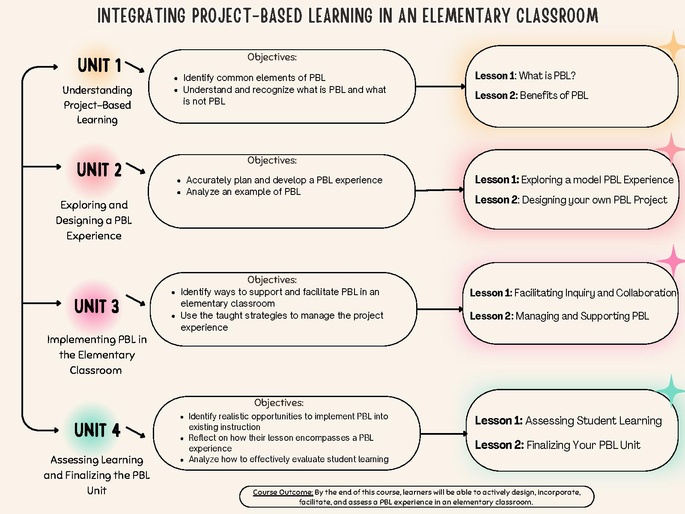
Unit 1:
Understanding Project-Based Learning
After this unit, learners will be able to:
- Identify common elements of PBL
- Understand and recognize what is PBL and what is not PBL
Unit 2:
Exploring and Designing a PBL Experience
After completing this unit, learners will be able to:
- Accurately plan and develop a PBL experience
- Analyze an example of PBL
Unit 3:
Implementing PBL in the Elementary Classroom
After completing this unit, learners will be able to:
- Identify ways to support and facilitate PBL in an elementary classroom
- Use the taught strategies to manage the project experience
Unit 4:
Assessing Learning and Finalizing the PBL Unit
After completing this unit, learners will be able to:
- Identify realistic opportunities to implement PBL into existing instruction
- Reflect on how their lesson encompasses a PBL experience
- Analyze how to effectively evaluate student learning
Curriculum Map
References and Resources
- ...