Elizabeth's Portfolio
Intent & Purpose
The intent of this course is to give educators a glimpse of what a Montessori classroom looks like, feels like, and operates like. We will take a look at three main components. These topics will include:
- The Physical Environment
- The Peaceful Environment
- The Pupil's Environment
Learning Outcomes
Gagne believed that instructional planning could be vastly simplified by categorizing learning objectives into one of five major categories (Gagne, 1985). Each of the categories represents a different set of instructional conditions for effective learning. Categories include intellectual skills, cognitive strategies, verbal information, attitude and motor skills. Outcomes are made possible by the acquisition of learned capabilities, which are viewed as changes in the learner's stored memory. Some of these outcomes will be incorporated throughout this mini-course.
Intellectual Skills- Learners in this course will apply basic Montessori philosophy principles in the design on their own classroom learning environment.
Cognitive Strategies- Learners in this course will keep a reflection journal in order to govern their own learning, remembering, and thinking behavior.
Attitude- Learners in this course will choose from various Montessori philosophy based management strategies that promote peace and respect and apply the skills and strategies to their own learning environment.
Needs Assessment
In order to successfully complete the needs assessment for this course, a survey was created and administered. The survey was given in order to assess beliefs, opinions, and knowledge about the classroom learning environment. This cost-effective data source will provide a sampling of an accurate cross section of a variety of data sources. The results will provide insight into the prior knowledge of the course participants. As results from the survey are received, modifications to this course design will be altered.
This survey asked participant to describe what they believe to be the most significant issues in their ideal learning environment. The survey consisted of three core sections, each representing a different aspect of learning environments. Section one focused on the teachers’ role in the learning environment. Section two looked at students’ opportunities. In section three, participants were asked to consider the overall atmosphere of the classroom.
Participants were asked to rate each item of the section (using the scale provided below) in terms of its significance or importance to their learning.
Rating Scale:
- Not at all significant
- Somewhat significant
- Moderately significant
- Very significant
32 surveys were emailed and 11 were returned. The following graphs illustrate the results. These results will be analyzed and use to structure some of the content pertaining to this mini-course. Please click on the image of the graph to see the results in expanded form.
-
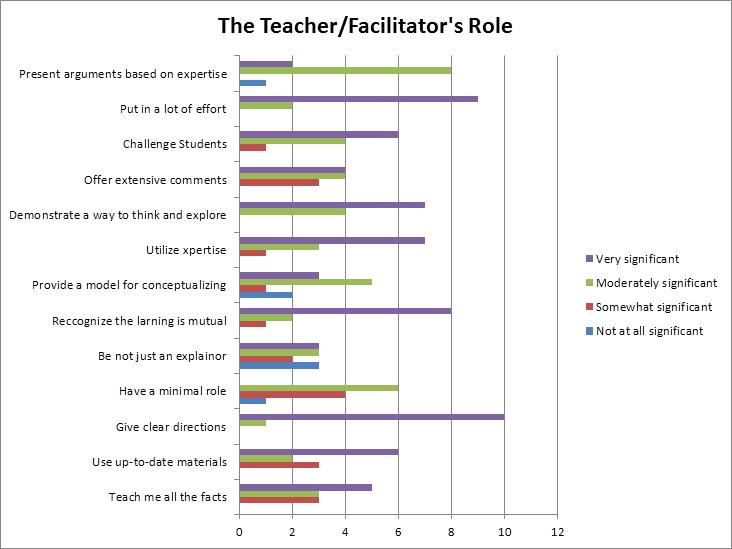 Needs Assessment Results Teacher/Facilitator Role
-
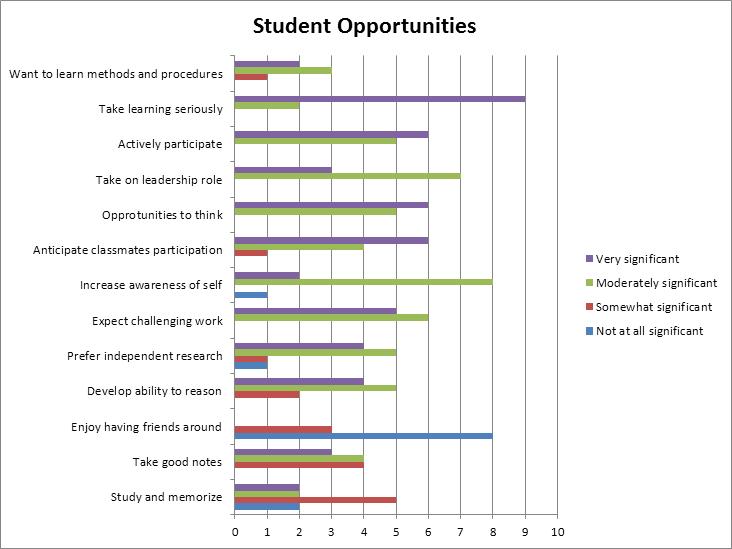 Needs Assessment Results Student Opportunities
-
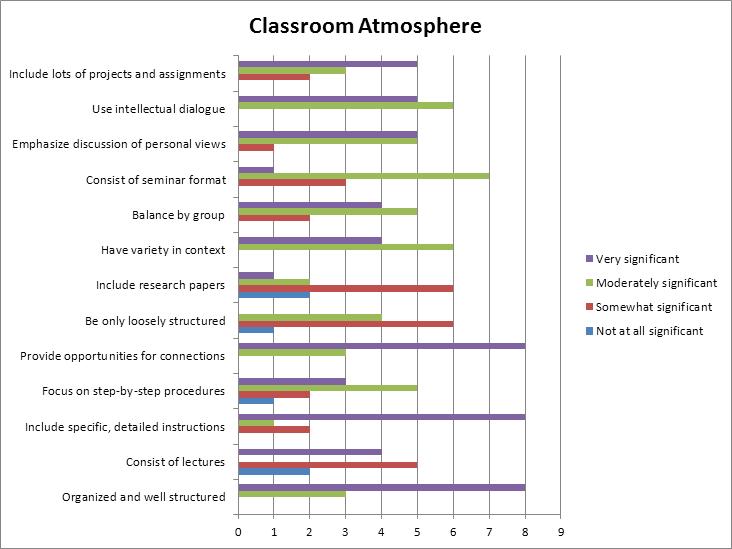 Needs Assessment Results Classroom Atmosphere


Direct Link to the Survey: http://www.surveymonkey.com/s/SNDDQ5K
Instructional Intent (Ideal): The Montessori teacher functions as a role model, demonstrator, record keeper, and meticulous observer of each child’s behavior and growth. Like students, they are an active and curious learner. A delight in continual inquiry and growth and a respect for each child’s unique learning styles and interests are among key qualities. It is the Montessori teacher who prepares the active, developmentally appropriate learning environment, furnished with specially designed materials, where students explore, discover, and experience the joy of learning. It is my intent that participants in this course will be given a overview as to what a Montessori learning environment looks like and how the Montessori theory can be adapted into a variety of classroom settings. Participants will be encouraged to use some of these strategies in classrooms of their own in order to see some of the benefits of this way of teaching.
Intended Learners (Reality): This mini-course is intended for teachers who are new to Montessori education. This course can also be used by parents of Montessori school children because it lends itself as a brief insight as to what their child's classroom looks like.
Instructional Context (Reality): Throughout this course, a variety of media resources will be used. Participants will use readings, videos, as well as other virtual software programs as they navigate through each unit. Participants will also use a journal throughout this course to log observations and reflections.
Summarize and Revise (Goal): It is my intent that upon completion of this mini course, learners will be able to apply the knowledge, skills, and strategies to thoughtfully and purposefully create a Montessori learning environment. Special focus will be given to the main characteristics of the prepared environment, including:
- Self-correcting Materials
- Individualized Learning
- Concrete Foundations
- Active Learning
- Emphasis on Peace and Respect
Performance Objectives
After successfully completing this course, learners will be able to
- Construct a model of what a Montessori classroom physically looks like
- Implement a classroom management strategy that promotes peace
- Develop a pupil-centered approach when creating lesson plans
Task Analysis
"Task analysis for instructional design is a process of analyzing and articulating the kind of learning that you expect the learners to know how to perform" (Jonassen, Tessmer, & Hannum, 1999, p.3).
In order for the learners of this course to successfully complete the work, the following prerequisites need to be considered:
Essential Prerequisites:
- Learners need to demonstrate the ability to use the internet.
- Learners need to demonstrate the ability to navigate through an online Wiki course.
- Learners need to demonstrate the ability to read text and analyze perspective.
- Learners need to demonstrate the ability to watch a video and identify.
- Learners need to demonstrate the ability to use a "virtual classroom" software program.
- Learners need to demonstrate the ability to develop a comprehensive lesson plan.
Supportive Prerequisites:
- Learners need to show interest in fostering a child's independent growth and assist children to learn at their own pace through self-correcting lessons.
- Learners need to be supportive of a Constructivist teaching model.
- Learners need to be intrinsically motivated.
- Learners need to be open to new ideas that might be outside of their "comfort zone".
- Learners need to be open to self-reflection.
Curriculum Map
Click the thumbnail below to see the curriculum map that aligns with this course.
