Determining Surface Area

Introduction to Task:

Students have a hard time memorizing complex formulas simply because the formulas do not always make sense to the students. So as educators, we must teach students alternative methods for producing formulas that do not require the regurgitation of memorized recipes. Students must build their problem solving abilities in the classroom in order to tackle the larger, more complex, mathematical problems they may face in their future careers. Students need time to tinker, explore, test, and develop solution methods that make sense to them as problem solvers. “Mathematics is a form of sense making, a result of which is that the patterns and procedures, and results all cohere in a meaningful way” (Darling-Hammond, 2008, p. 114). It is with this task that the students will have a chance to explore the cylinder and ultimately discover its formula.
Reason for implementing task:
- According to NCTM: "Whenever possible, students should develop formulas and procedures meaningfully through investigation rather than memorize them"(NCTM, 2000, p. 244).
- "Problem solving means engaging in a task for which the solution method is not known in advance. In order to find a solution, students must draw on their knowledge, and through this process, they will often develop new mathematical understanding" (PSSM, 2000).
Procedure for Lesson:

- Split the students up into groups of four and tell them that they will need to help Lizzy solve a specific problem that she is having trouble with. Tell them that they will have paper, scissors, pencils, rulers, and the written task as materials to use while they work to find different solution methods for the given problem.
- Now explain and hand out the given task.
- The Task/Problem:
- Lizzy needs to figure out (1.) what the flat pattern of a cylinder looks like for her engineering course and then she needs to (2.) find the formula of the surface area of that same cylinder. However, she does not have a textbook, the Internet, a cell phone, or any other way to look up the answer. What she does have is a stack of scrap paper, a pair of scissors, a ruler, and a pencil to work with. Using the same materials, see if you can help Lizzy with her task.
- Note: While you are cutting, sketching, and thinking, please keep a running list of your ideas, including those that did not work. For example, if you cut out an image that did not fold up to be a cylinder, make a note on that image explaining its inconsistencies.
- For Example:
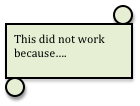
- For Example:

- Questions to think about:
- How many solution methods are there? Can there be more than one flat pattern? What is the surface area of a cylinder? How do you know that the formula you have created is correct? Explain.
- Questions to think about:
- What you will need to hand in:
- Please keep all of your sketches and cut out’s neatly stacked together to be handed in. Also, I would like to see your discovered formula along with a detailed explanation of how you discovered it and why your formula makes logical sense.
- 3. While students are working with one another, circulate around the room addressing questions (as long as they do not take away from the investigation).
- 4. Presentation: When the groups are finished have each one present their findings to their classmates.
- 5. Collect all of their work in order to provide feedback
Back to Unit 2: Designing Problematic Tasks
References and Resources:
Darling-Hammond, ML. (2008). Powerful learning:what we know about teaching for understanding. San Francisco, CA: Jossey-Bass
National Council of Teachers of Mathematics (NCTM). 2000. Principles and Standards for School Mathematics. Reston, VA: NCTM
Principles and Standards for School Mathematics. (PSSM). National Council of Teachers of Mathematics Standards. (2000). Retrieved April 22, 2011, from http://standardstrial.nctm.org/document/chapter2/index.htm.