Brejai DeGallerie's Portfolio Page
Navigation links: ETAP 623 Fall 2026 | Link to my mini-course front page

About Me
My name is Brejai DeGallerie. I currently reside in the lower Westchester area. I graduated from Texas Tech University with my bachelor's degree in Elementary Education. I am now enrolled in the CDIT masters' program at the University of Albany. In my career as a teacher I have worked in a variety of settings including special education, lower and upper elementary. I am a certified Elementary School Teacher and currently work as a middle school social studies teacher. I volunteer for community support services and work to support my students in and out of the classroom.
My Topic and Purpose
The topic of my mini-course is Bridging the Past: Designing Meaningful Connection in Social Studies. In my career, student connection to history has been a large chasm. It is a topic that is ripe with potential for students to grow not only as learners but also as global citizens. In a world where information is at our disposal, a learner's ability to recognize patterns, analyze context, and make connections across time will be their best assets in the new digital age. Teachers who are willing to start with student knowledge and experience as the foundation of learning can promote these skills. The goal of my course is to center student experiences in social studies when instructing, by encouraging connection to new information and historical concepts.. The purpose of this course is to provide educators and designers with the tools necessary to begin introducing student knowledge, experiences, and their point of view into existing curriculum.
Scope of Learning Outcomes and Content
For secondary teachers in social studies, this course will equip them with a practical framework for leveraging student prior knowledge and experience continuously throughout a lesson. By the end of this course, the learner should be able to :
- Determine the difference between activating and leveraging student experience.
- Identify meaningful experiences and content connections.
- Use the Hess Cognitive Matrix to evaluate existing inquiry around student experiences.
- Use the Hess Cognitive Matrix to design high rigor questions centering student experiences and knowledge.
- Redesign lessons for student experience and knowledge to be leveraged throughout the lesson.
Needs Assessment
Instructional Problem
There is an increasing demand for educators to integrate rigorous inquiry and project-based learning across all subjects. This poses a difficult quandary for social studies educators. The academic focus of social studies instruction has shifted to focus on creating critical thinking, and civically-engaged students who are able to analyze and connect problems across time. This is a far cry from the rote memorization of dates and facts of the past. Social Studies educators are faced with many hurdles to develop these types of students. Students have less foundational knowledge in social studies than in previous decades. This is due to the emphasis of standardized testing in areas of English Language Arts and Math; it has sidelined other content areas. The consequences of this is educators are faced with students who have a diminished knowledge of foundational information while there is a simultaneous demand for increase in rigor and critical thinking to create civically engaged students. These instructional hurdles are compounded when we consider students are having less authentic civic interactions outside of school, leaving educators increasingly responsible for meaningful, authentic opportunities for civic engagement while meeting standards and curriculum requirements.
The Nature of What is to be Learned
Educators taking this mini-course will be able to:
- Define prior knowledge and its role in learning and student achievement.
- Identify opportunities within the existing curriculum for connecting student experiences to content.
- Design inquiry-based learning experiences that use student knowledge and experience as the foundation for historical analysis.
- Modify existing lessons to increase student engagement and critical thinking.
Learner Profile
The learners are secondary teachers of social studies with a specific focus on the middle school age range. These learners typically work in a public school system and face curriculum and pacing constraints that play a role in instructional decision-making. These learners are familiar with state standards and have a strong background in lesson planning and design. They may have limited formal training in inquiry based instruction. The learner is interested in adapting or designing curriculum to help students create strong connections between their own experiences and social studies content. Whether they are new teachers or well into their career as seasoned educators, this learner is interested in adding tools to their practice that help them design and implement ways for students to connect learned content with experiences to deepen understanding.
Existing Efforts to Address this Gap
There is an abundance of research on prior knowledge, inquiry based learning, and project-based learning. Most current practices treat these as separate entities. Teachers may learn practical, low-rigor strategies that activate student knowledge and allow them to reflect on their own experiences while providing insight to the educator on student understanding. They may also learn strategies to facilitate inquiry. However, there are few practical frameworks for integrating student experiences into rigorous social studies standards. The current gap exists because educators may understand the importance of activating prior knowledge and know how to elicit student experience and background knowledge, but only as an introduction to the content. As a result, student experience may be elicited but not serve as a foundation for ongoing inquiry. Educators need practical frameworks and strategies that center student experience and knowledge throughout instruction and allow for rigorous inquiry and deep analysis of content.
Intent Statement
This mini course will equip secondary teachers with a practical framework for leveraging student prior knowledge and experience. This framework will help educators adapt existing curriculum into rigorous, inquiry based learning opportunities within the existing curriculum that deepen understanding and support the development of civically engaged learners.
Analysis of the Learner and Context
Learner
Participants of this mini course will be teacher candidates or full-time teachers. This course is available to anyone who has interest. It is designed for secondary teachers of grades 6-9 social studies at public schools. Learners may have a range of experience but they should have a background teaching secondary social studies content.
Instructional Context
Participants will engage in learning by engaging with the mini-course through the KNILT platform. Participants will be able to go through the mini-course asynchronously and access the modules in the order of relevance. Ideally, the learner should be able to use the mini-course to review their existing curriculum and identify opportunities for implementation of the course content. For teacher candidates, this course should provide a framework and strategies for instructional planning.
Goals
After the completion of this course, it is the goal of the creator that participants will be able to examine existing lessons and curriculum and develop rigorous inquiry around student experiences. Educators will be able to distinguish meaningful student connections and develop conceptual understandings of content. This course also has the goal of moving educators beyond activating prior knowledge and into leveraging it throughout instruction using a framework.
Performance-Based Objectives
After completing this mini-course, learners will be able to:
- Explain the impact of prior knowledge and student experience on learning and engagement
- Differentiate between activating and leveraging prior knowledge.
- Generate conceptual understandings across social studies content and student experiences.
- Analyze connections between student experiences and social studies content to determine relevancy.
- Evaluate how student experiences will function within inquiry and disciplinary thinking.
- Design rigorous inquiry that leverages student experiences to deepen disciplinary thinking
- Redesign lesson plan to center student experiences in inquiry-based learning.
Task and Content Analysis
Before taking this course, participants should be able to:
- Identify state/district standards and instructional objects
- Translate standards into lesson plans.
Unit 1:
After this unit the participants will be able to:
- Understand sources of prior knowledge and how it developed
- Identify types of student experiences that can contribute to learning.
- Explain the impact of prior knowledge and student experience on achievement
Participants will take a self-assessment quiz based on their use of student prior knowledge and experience in instruction.
Unit 2:
After this unit the participants will be able to:
- Describe the purpose and function of prior knowledge.
- Define “Leveraging” prior knowledge
- Describe the purpose and function of leveraging prior knowledge.
- Analyzing opportunities for leveraging or activating prior knowledge.
Participants will analyze scenarios to determine opportunities for leveraging or activating student prior knowledge and experiences.
Unit 3:
After this unit the participants will be able to:
- Describe conceptual understandings
- Understand disciplinary skills and thinking
- Understand how disciplinary thinking and conceptual understanding support instructional content
Participants will review a lesson plan and distinguish the conceptual understanding and disciplinary thinking.
Unit 4:
After this unit, the participants will be able to:
- Define meaningful connections.
- Apply disciplinary thinking to investigate student experiences and meaningful connections.
- Develop inquiry around meaningful connections and student experiences.
Participants will identify a meaningful connection between a student experience and conceptual understanding and develop inquiry that investigate the connection.
Unit 5:
After the unit the participants will be able:
- Develop leverage using componets of students 'experiences, conceptual understanding ,and disciplinary thinking.
- Develop inquiry through meaningful connection and identified leverage.
- Embed opportunities into existing lesson.
Participants will develop "leverage: and embed it into existing lesson plan.
Curriculum Map
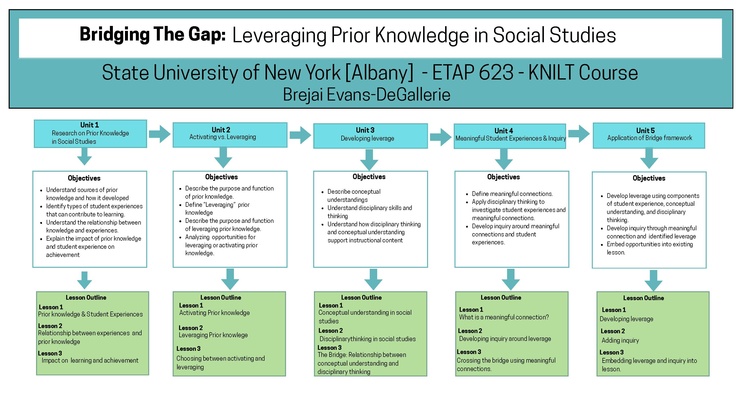
References and Resources
- ...